
Updated: 2026-06-17 | Fares, schedules, policies, etc. change easily; please refer to each operator’s official announcements for actual details
In Taiwan, taking the high-speed rail from Taipei to Kaohsiung in 90 minutes is almost taken for granted. But Canada is 270 times the size of Taiwan, has no high-speed rail, and many provinces have no direct train service between them at all; even where it exists, it is not necessarily faster or cheaper than flying. Canada’s transportation logic is completely different: short distances rely on driving, medium distances rely on flying, and long distances still rely on flying. For many routes the best answer is actually “the plane,” not the “public transit” that most Asians instinctively think of first. What this article wants to share with you is not just which modes of transport exist, but more importantly: across different distances, seasons, and budgets, which mode you should actually choose to get around.
Before planning any trip in Canada, it is important to first build a “sense of distance,” because almost every newcomer dramatically underestimates how big Canada is. Vancouver to Victoria cannot be driven directly; you take a ferry of about 1.5 hours and then drive 30 minutes, for a total of about 2.5–3 hours. Vancouver to Whistler is about 125 km; taking the Sea-to-Sky it is 1.5–2 hours by car and about 2.5–3 hours by bus. Vancouver to Banff is about 850 km; driving takes 9–10 hours, so most people choose to fly to Calgary and then drive 1.5 hours. Calgary to Banff is about 130 km, about 1.5–2 hours by car or bus; Calgary to Jasper is about 415 km, 4–4.5 hours by car, most beautiful via the Icefields Parkway. Over in the east, Toronto to Niagara Falls is about 130 km, 1.5 hours by car or about 2 hours by GO Bus; Toronto to Ottawa is about 450 km, 4.5–5 hours by car or bus and 1 hour by plane; Toronto to Montreal is about 540 km, about 5 hours by VIA Rail, 5–6 hours by bus and 1.5 hours by plane; Montreal to Quebec City is about 260 km, 2.5 hours by car and about 3 hours by train.
The most crucial sentence: Vancouver to Toronto takes about 45 hours by car (non-stop) and about 5 hours by plane. Canada spans 6 time zones from east to west, longer than the straight-line distance from Taipei to London. For any inter-provincial trip, the plane is almost always the most reasonable choice. The table below is a quick overview of the speed, price, and suitable scenarios for each mode of transport (prices are approximate ranges, in CAD):
| Mode of transport | Speed | Price | Flexibility | Best for |
|---|---|---|---|---|
| Domestic flight | Very fast | $50–400 | Medium (schedule limits) | Inter-provincial, over 500 km |
| Self-drive | Fast | Fuel + parking | Highest | Scenic areas, countryside, group trips |
| Long-distance bus | Medium | $20–80 | Medium | Saving money, short intercity |
| Train (VIA Rail) | Medium | $40–300+ | Medium | Toronto–Montreal sightseeing experience |
| Ferry | Slow | $15–90 | Low | BC Ferries, between island cities |
| City metro / bus | Medium | $3–5/ride | Low | Getting around within the city |
| Rideshare (Poparide) | Medium | $15–50 | Medium-low | Saving money, fixed popular routes |
| Small group tour | Medium | $80–300/day | Low | Car-free travellers, special attractions |
| Uber / Lyft | Fast | $10–50 | High | Short distances, downtown, airport |
How to choose among the various modes of transport
Domestic flights are Canada’s most important inter-provincial mode of transport, and many times they are more cost-effective than you would imagine. Air Canada is the national carrier, with the most routes and the most complete Aeroplan mileage program, but fares are on the high side and baggage fees are expensive; WestJet is the second largest, strong on western routes and slightly cheaper, with fewer eastern routes; Porter Airlines departs from Toronto’s island airport (downtown) and has high service quality, but its routes are concentrated in the east with no west coast; Flair Airlines is a “value carrier” focused on low prices, with promotional fares sometimes $40–80, but baggage, seat selection and almost everything else costs extra and on-time performance is less stable (Flair has stated in recent years that it is no longer a pure ULCC, but the essence of “low fares, add-on services charged separately” has not changed). When a route exceeds 500 km (Vancouver→Toronto, Calgary→Toronto), or when you are short on time and don’t want to spend 8–10 hours on the road, the plane is the top choice; for a distance like Toronto↔Montreal, train and plane take about the same time, but the plane is often cheaper. To save money, booking 4–8 weeks in advance is usually 30–60% cheaper than booking 1 week before departure; Flair promotional fares are sometimes cheaper than the train; make good use of Google Flights’ “lowest fare calendar” to find the cheapest departure day, and accumulate Aeroplan miles to redeem for free tickets. Pay special attention to baggage: Air Canada / WestJet usually include one carry-on, with checked baggage costing extra around $30–60; Flair charges extra even for carry-on baggage, so when comparing, calculate the total cost of “fare + baggage fee,” not just the face value of the ticket.
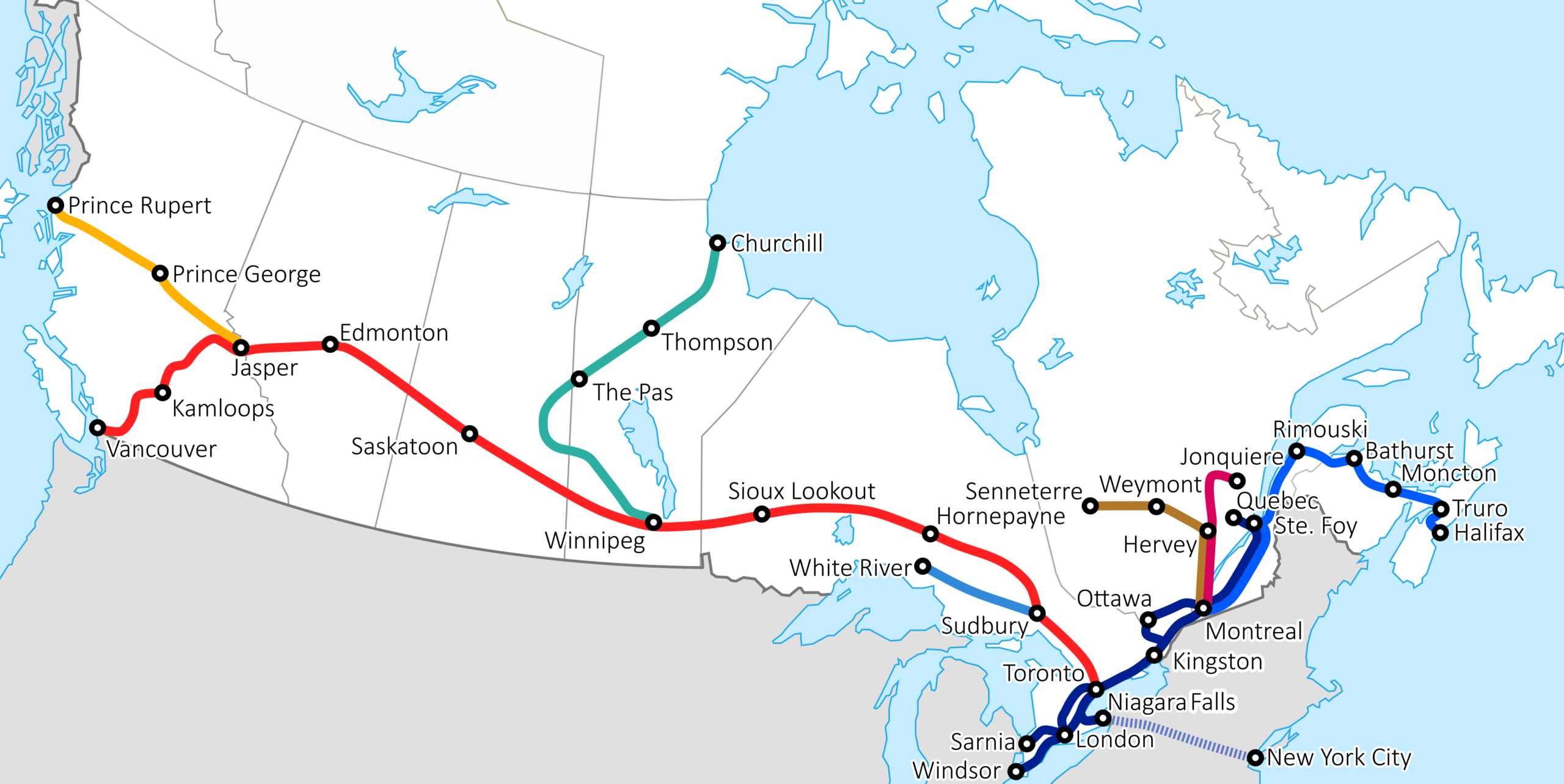
The train (VIA Rail) in Canada is a sightseeing tool, not a commuting tool. If you expect a train like the Shinkansen or Taiwan’s high-speed rail, Canada will disappoint you—there is no high-speed rail, VIA Rail’s top speed is about 160 km/h (usually slower), services are sparse and the delay rate is high. The most worthwhile to ride is Toronto→Montreal (about 5 hours, about $60–150): high frequency, good scenery along the way, and city-centre to city-centre without going to the airport; Montreal→Quebec City (about 3 hours) has beautiful scenery; Toronto→Ottawa (about 4.5 hours) suits business trips for those who don’t want to drive. The advantages are city-centre to city-centre, the ability to walk around and enjoy the scenery with a dining car, and generous baggage at no extra charge; the disadvantages are that it is slower than the plane and often delayed, with infrequent service, and the west (BC) has almost no inter-provincial passenger rail. In addition, the Rocky Mountaineer is a private luxury sightseeing train (Banff / Jasper ↔ Vancouver) where “riding the train itself is the travel experience,” costing about $1,500–5,000+ USD per person, not an everyday mode of transport, but if you want to cross the Rockies in the most beautiful way, it is irreplaceable.
The long-distance bus is the most economical but most time-consuming. Greyhound withdrew from Canada in 2021, and is now filled in by several regional companies: Rider Express (BC, Alberta, Vancouver ↔ Calgary, the most important in the west), Ebus (BC intercity, business style with Wi-Fi), Red Arrow (the top choice for inter-provincial Alberta, Calgary ↔ Edmonton ↔ Banff, frequent service and high on-time rate), FlixBus (Ontario, Quebec, Toronto ↔ Ottawa ↔ Montreal), Maritime Bus (Atlantic provinces), GO Transit Bus (Greater Toronto Area, commonly used for the Niagara Falls route). In practice, the Vancouver→Calgary bus is about 15 hours $80–120 and the plane is about 1.5 hours $100–200, so in most cases you would choose the plane; the Toronto→Ottawa bus is about 5 hours $25–50, and for short distances the bus saves money; the Red Arrow from Calgary→Banff is about 1.5 hours $20–35, the most economical way to reach Banff.
City public transit is completely different in each city. Greater Vancouver (TransLink) has a three-line SkyTrain connecting Vancouver to Surrey, Burnaby and Richmond, and the SeaBus ferry runs every 15 minutes to and from North Vancouver, charged by tapping in and out with a Compass Card, about $3.15–5.50 per ride (by Zone) and about $115–185 for a monthly pass. Greater Toronto (TTC / GO) relies on the TTC (subway + streetcar + bus, about $3.30 per ride) downtown, GO Transit serves suburban commuter rail and buses, and the UP Express runs from Pearson airport to Union Station in about 25 minutes for $12.35, with the Presto Card as the integrated card. Montreal (STM / REM) has the most complete Métro (one of the oldest subways in North America, signage mainly in French) + buses, and the REM automated light rail that opened in 2023 connects downtown to the airport, using the OPUS Card, about $3.75 per ride. Calgary / Edmonton each have a C-Train / LRT light rail + buses (downtown Calgary has a free-ride zone), but Alberta cities have low public transit coverage and getting around without a car is very inconvenient; reaching Banff / Jasper almost requires self-driving or joining a tour.
The ferry in BC holds a status similar to that of the freeway in Taiwan—it is an essential mode of transport, not an optional itinerary. BC Ferries‘ most popular is Tsawwassen→Swartz Bay (Victoria), about 1.5 hours, suitable for driving to Victoria; Horseshoe Bay→Departure Bay (Nanaimo) about 1.5 hours is the main route to Vancouver Island; Port Hardy→Prince Rupert (Inside Passage) about 15 hours is more of a sightseeing significance. Note: on long weekends and during the July–August summer holidays you must reserve online; queuing on site does not guarantee getting on your intended sailing and you may have to wait for 2–3 sailings; the fee for bringing a vehicle on board varies by vehicle type and route (a single standard vehicle including the driver is already several tens to over a hundred Canadian dollars, while a walk-on passenger is much cheaper), and there is now also a reservation option that lets you book first without paying first, with the relevant amounts to be confirmed via BC Ferries officially; the BC Ferries App can check real-time wait times. Other ferries also include TransLink SeaBus (Vancouver ↔ North Vancouver, every 15 minutes, Compass Card accepted), Toronto Island Ferry (to the Toronto Islands, crowded in summer with waits), and Marine Atlantic (Nova Scotia ↔ Newfoundland, 12–17 hours crossing the Cabot Strait).
Self-driving and car rental are the freest way to get around Canada, and many of the most beautiful places are almost impossible to reach without driving: Moraine Lake, the Icefields Parkway, Tofino, Cape Breton Island. Car rental is about $40–120/day (excluding insurance and fuel), with CDW / LDW insurance adding about $15–35/day; the upside is one-way rental (pick up in one city, drop off in another) and it is very cost-effective for a single trip; with your own car you only need fuel + parking, the most economical for long distances with several people. Popular rental companies: Enterprise / National / Alamo (nationwide chains, the widest coverage and most reliable), Hertz / Avis / Budget (large chains, most present at airports), Vancouver’s Evo (per-minute carshare, no reservation needed, suitable for spontaneous in-city use), Modo (membership-based, charged by the hour), Turo (a peer-to-peer car rental platform from individual owners, sometimes cheaper but with more complicated insurance). When self-driving, note: in winter (November–March) BC mountain roads mandatorily require winter tires or carrying tire chains; parking fees are about $5–8/hour in downtown Vancouver and about $4–7/hour in Toronto; fuel prices differ by province, with BC the most expensive nationwide (about $1.8–2.2/L). For further reading, see the complete Canada Car Rental Complete Guide and the Complete Guide to Winter Driving in Canada.
Private small group tours (Small Group Tours) usually refer to tours of 4–15 people, led by a local guide driving a van or SUV, more flexible and private than big-bus tours, often able to reach places big buses cannot, and a good solution for car-free travellers. Suitable for: those who can’t drive, destinations that public transit can’t reach (Moraine Lake bans private cars in peak season, aurora spots are far from the city and need someone to explain things), or those travelling solo who don’t want to be alone. Common routes and approximate costs: Banff + Lake Louise (departing Calgary) $80–150/person, the Moraine Lake peak-season-only small tour $60–120/person, the Yellowknife aurora tour $120–250/person, Whistler (departing Vancouver) $60–120/person, Tofino $100–180/person; for Churchill polar bears you must join a Tundra Buggy, $300–500/person/day. Overall, large tour-bus groups (20–50 people) are the cheapest but with fixed itineraries and short stops; small boutique tours are mid-priced, highly flexible, and suitable for first-timers; self-driving is the most expensive but the freest.
Rideshare is cheaper than the bus and freer than a small tour, and the culture is quite active on fixed popular routes. Poparide (poparide.com) is currently the most mainstream formal platform: it has two-way ratings, transparent fees (usually $15–50 per person), and the platform takes about $2–3/booking in service fees; on popular routes such as Vancouver ↔ Whistler, Vancouver ↔ Calgary, and Toronto ↔ Montreal, it is about 20–50% cheaper than the bus. Craigslist Rideshare is a long-standing informal channel (your city → Community → Rideshare), cheaper but without a rating system, so you have to judge reliability yourself; common ones are Vancouver→Whistler, Calgary→Banff/Jasper, Toronto→Ottawa/Montreal. In addition, searching Facebook for keywords like “Vancouver Rideshare” turns up large communities, and Discord and WhatsApp also have rideshare channels in immigrant communities. On safety: for informal rideshares it is advisable to confirm by video call first, tell family and friends your plan and the other party’s information, and prioritize Poparide the first time; for payment, Poparide mostly uses credit cards, while Craigslist usually uses e-Transfer.
Applying these modes to popular routes, the most recommended choices are roughly as in the table below (prices and times are approximate ranges):
| Route | Plane | Train | Bus | Rideshare | Small tour | Self-drive | Recommended |
|---|---|---|---|---|---|---|---|
| Vancouver→Whistler | No flights | None | $25–40 / 2.5–3hr | $20–35 / 2–2.5hr | $60–100 incl. guide | Fuel / 1.5–2hr | Self-drive / rideshare |
| Vancouver→Victoria | $80–150 / 35min | None | +ferry $40–60 / 3–4hr | +ferry $30–50 / 3–4hr | $80–150 day trip | Ferry+drive / 2.5–3hr | Self-drive + ferry |
| Vancouver→Banff | Fly to Calgary $150–250 + car rental 1.5hr | No direct | $80–130 / 14–15hr | $60–100 / 12–14hr | $150–300 / 2 days | 9–10hr overnight + fuel | Fly to Calgary + car rental |
| Calgary→Banff | Pointless | None | $20–35 / 1.5–2hr | $15–25 / 1.5hr | $80–150 incl. attractions | 1.5hr, freest | Self-drive / small tour |
| Calgary→Jasper | Pointless | No direct | $50–80 / 5–6hr | $30–60 / 4–5hr | $150–300 / 2 days icefield | 4–4.5hr via Icefields | Self-drive (Icefields Parkway is the most beautiful) |
| Toronto→Niagara | Pointless | None | $20–35 / 2hr | $15–25 / 1.5hr | $60–120 incl. guide | Fuel / 1.5hr | Small tour / rideshare / GO Bus |
| Toronto→Ottawa | $80–200 / 1hr | $60–120 / 4.5hr | $25–50 / 5hr | $20–40 / 4.5hr | Rare | Fuel / 4.5hr | Bus / rideshare to save money; plane is fast |
| Toronto→Montreal | $80–200 / 1.5hr | $60–150 / 5hr | $30–70 / 5–6hr | $25–50 / 5hr | Rare | Fuel / 5.5hr | VIA Rail offers a good experience; rideshare saves money |
Installing a few apps before your trip will save a lot of trouble: Google Maps (all-around for public transit + driving navigation, integrating TransLink/TTC/STM), Transit App (real-time bus / metro arrivals more accurate than Google Maps, best in Vancouver and Toronto), Uber and Lyft (available in major cities, you can see estimated prices in advance, and some cities allow price comparison), Poparide (rideshare search and booking), BC Ferries App (schedules, real-time waits, reservations, essential in peak season), Air Canada App (boarding, flight status, Aeroplan), Google Flights (price comparison + lowest fare calendar), as well as city stored-value card apps: Compass Card (BC), Presto (Ontario).
? Essential travel tools
The things newcomers most easily get wrong
Let me share a few of the pitfalls newcomers most often fall into. The most fundamental is thinking Canada has high-speed rail and that the train is faster than the plane: Canada has no high-speed rail at all, VIA Rail’s fastest is only 160 km/h and it is often delayed; the Toronto→Montreal train is 5 hours and the plane is 1.5 hours, and even counting the time to get to the airport, the plane is still faster in most cases. Conversely, don’t assume the plane is always more expensive than the train—a Flair promotional fare is sometimes $40–80, cheaper than VIA Rail, but don’t forget that a Flair $50 ticket + $28 carry-on + $40 checked baggage actually comes to over $100, so calculate the total cost; almost all Canadian carriers’ economy class excludes checked baggage, and adding it in advance is cheaper than on site. For overall planning, don’t use a Japan / Taiwan mindset: Taipei→Kaohsiung is 90 minutes, Vancouver→Toronto is 45 hours by car—completely different scales.
Regional details also often go wrong: BC Ferries must be reserved in advance, and on long weekends and the July–August peak season, without a reservation you may wait for 2–3 sailings (several hours); although Calgary has a bus to Banff, service is infrequent and the wait on the return is long, so most people find self-driving or a small tour more practical; Moraine Lake bans private cars in peak season, and from June–October you must take the designated shuttle or join a small tour; prepare for driving mountain roads in winter—the Sea-to-Sky, Rogers Pass, etc. mandate winter tires or chains from November–March, and being unprepared brings fines and danger; car rentals basically do not include CDW collision insurance, and if you don’t buy it the cost of an accident is staggering; downtown parking is very expensive (Vancouver / Toronto $5–8/hour, up to $30–60 for a full day). On city transit cards: the TransLink SkyTrain and some buses charge by Zone and require tapping out, and forgetting to tap out will deduct the maximum fare; GO Transit mainly serves the suburbs, so use the TTC within the city; the SeaBus is a formal commuter tool (not a sightseeing boat) and the Compass monthly pass is valid. Other points: rural areas and small cities have low Uber coverage, so confirm in advance; the REM does reach Trudeau airport, but to reach downtown you transfer to the STM Métro, taking about 50–60 minutes overall; the Icefields Parkway (Calgary→Jasper→Banff) is about 230 km one way with many attractions, and it is strongly recommended to stay at least one night rather than doing a same-day round trip; for rideshare the first time, use Poparide which has rating protection, and don’t get in a vehicle without confirming the other party’s background.
Let me clear up a few common questions all at once: the order of cheapest for long distances is roughly rideshare (Poparide / Craigslist) > long-distance bus > booking Flair in advance (including a minimal backpack) > VIA Rail discount fares > a regular plane ticket; the core principle is “the earlier you book the cheaper, avoid long weekends, and flexibly choose to depart Tuesday / Wednesday.” Canada has no nationwide transit pass; VIA Rail has a “VIA Rail Pass” aimed at non-resident travellers (7–10 trips within 30 days, limited coverage), and city monthly passes are only valid within that city’s system and do not cross cities. You can rent a car short-term without a Canadian licence (usually within 90 days) using a valid Taiwanese or other country’s licence; some companies require you to present both your passport and an English translation of the licence (such as an ICBC-recognized translation); if you reside long-term it is advisable to switch to a local licence as soon as possible—you may refer to the Complete Guide to Canadian Driver’s Licence Classes. Uber and taxis: in most cases Uber is cheaper and lets you see an estimate in advance, but airport taxi queues have fixed rates not subject to surge, so when leaving the airport, if Uber shows surge pricing, a taxi may instead be cheaper. Carshare (Evo, Modo) is “on-demand car rental” with no reservation, unlocked via an app and charged by the minute/hour, suitable for occasional car use but not for long distances (there are service-area limits) or daily commuting (the cost is on the high side).
Let me also organize airport-to-downtown. For Toronto Pearson, the fastest is the UP Express to Union Station, about 25 minutes, $12.35 (Presto, even lower with the TTC transfer discount); the most economical is the TTC bus 900 Airport Express → Kipling subway station, about 1 hour, $3.30; Uber is about 35–55 minutes $40–70, and a taxi has a fixed rate of about $55–75. For Vancouver YVR, the most convenient is the SkyTrain Canada Line direct to downtown in about 25 minutes, $3.15–5.50, available 24 hours; Uber/Lyft is about 30–45 minutes $30–55, and a taxi has a fixed rate by zone of about $35–40. For going to Banff / Jasper without a car, the most practical is to fly to Calgary and then take the Red Arrow to Banff ($20–35), or join a small tour from Calgary that includes Lake Louise ($80–150/person), or take the Rocky Mountaineer (ultra-luxury $1,500+); reaching Jasper is harder, relying mainly on car rental or a small tour. For going to Yellowknife to see the aurora, it is advisable to fly directly to Yellowknife from Toronto or Vancouver; there is no public transit locally, and aurora viewing is all transported by tour companies ($120–250/person); for details see the Complete Yellowknife Aurora Guide. For GO Transit to Niagara, take the GO Bus from Union Station, about 2 hours, $23–30 (better with Presto); after reaching the town the falls are within walking distance or take the WEGO bus. The Atlantic provinces (Nova Scotia, New Brunswick, Prince Edward Island, Newfoundland) have limited public transit and self-driving is the mainstream; Halifax has Maritime Bus connecting inter-provincial cities, and to reach Newfoundland you take the Marine Atlantic ferry or fly directly to St. John’s. For more road rules see the Complete Guide to Canadian Traffic Rules, or the Canada Newcomer Life Guide and the Complete Banff National Park Guide.
An alternative way to travel: the Alaska cruise
Many people, when planning a trip to Canada, only have planes, trains, and self-driving in mind, but the cruise is actually a very popular way, and also a strategy of “solving Alaska with a single suitcase.” Vancouver and Seattle are the world’s most important Alaska cruise home ports; every year from May–September dozens of large cruise ships depart from here, heading north through the Inside Passage into Alaska’s fjords and glaciers. For people living in BC, taking a cruise to Alaska is more reasonable than flying there—you live on the ship, the ship docks at a port city each day, you go ashore to sightsee for 6–10 hours and then return to the ship, then sail to the next stop, moving luggage only once, sleeping in the same bed, and waking up in a new place every day. Common durations are 5 days (basic), 7 days (most popular), 10 days (in-depth), and 14 days (including the round trip). The most popular is the 7-day round trip from Vancouver: departing from Canada Place, stopping at Juneau, Skagway and Ketchikan, crossing Glacier Bay or Tracy Arm Fjord in between to view glaciers, and finally returning to Vancouver—the advantage is no need to fly, boarding and disembarking in Vancouver, using a cruise shore-leave permit when stopping at Alaskan ports and entering Canada directly on the return.
The biggest myth about cruises is “seeing a $499 ticket and assuming the whole trip costs only $499.” The actual cost consists of two parts, the “cruise fare” and “onboard spending,” and neither is small. Taking a 7-day Alaska cruise for 2 people as a conservative estimate: the cruise fare (a basic interior cabin at about $499–799 CAD per person) is about $1,000–1,600 CAD; port taxes + service fees are about $180–250 USD per person (totaling +$500–700 USD); the mandatory gratuity is about $18–20 USD per person per day × 7 days (+$252–280 USD); drinks (a beverage package at $80–120 per person/day, or paying as you go at about $20–40/day, depending, +$280–560 USD); internet $15–35 USD/day (+$105–245 USD); shore excursions at $50–200 USD per person/day, choosing 3 days (+$300–1,200 USD), plus SPA / souvenirs and the like under your own control, so the total cost for two people easily reaches $4,000–7,000+ USD. Key reminder: the cruise fare can be priced in CAD, but almost all onboard spending is settled in USD, converted at the day’s exchange rate when you pay by card (or USD cash accepted directly), so don’t underestimate the whole trip’s total cost just because the cruise fare is cheap; it is advisable to bring a card with no foreign-currency fee (such as a Wise card) on board.
Choosing a cruise line can be based on style and clientele. Norwegian Cruise Line (NCL) features a freestyle approach (Free Style) with no fixed dining times, a cruise fare of about $500–1,200 CAD/person, a young atmosphere, and frequently promotes a Canadian Resident Offer priced in CAD, suitable for families and young couples. Princess Cruises is mid-to-high end and famous for its Alaska routes ($700–1,500 CAD/person), with the most routes, professional glacier commentary, and an “Alaska CruiseTour” cruise + inland train package, suitable for first-timers or those who want to understand the locale in depth. Holland America Line is mature high-end with meticulous service ($800–1,800 CAD/person), a clientele skewing 55+, quiet and elegant, with the longest Alaska pedigree, suitable for elders and travellers who value service. Royal Caribbean is mass-market, with the biggest ships and the richest onboard entertainment (rock climbing, surf simulators, ice rinks, $600–1,300 CAD/person), but some of the largest ships have too deep a draft to run Alaska, so confirm the route before booking; suitable for families with children who love onboard entertainment. Celebrity Cruises is mid-to-high-end boutique, strong on dining and design ($900–2,000 CAD/person, age range 35–65), and the Celebrity Edge series is especially suited to travellers who value aesthetics. Among these, NCL’s Canadian resident offer is worth mentioning: priced in CAD (not subject to exchange-rate fluctuations), the Free at Sea package (including drinks / shore-excursion credit / internet), and third and fourth passengers in the same cabin are sometimes free or heavily discounted; when 1 CAD ≈ 0.70 USD, $799 CAD equals about $560 USD actually paid, considerably lower than USD pricing, but this only applies to the cruise fare itself—onboard spending is still in USD. To find such offers, go to the NCL website and set residence to “Canada,” or contact an NCL-authorized travel agency in Canada.
A cruise is well suited to those who don’t want to move luggage frequently and want to see multiple Alaska locations at once (7 days can stop at 4–5 ports), families (Royal Caribbean / NCL have the most facilities), elders (Holland America has thorough service), couples on honeymoon (Celebrity / Princess are romantic and quiet), first-timers (Princess’s Alaska Tour package saves a great deal of planning), and wildlife lovers (whale watching at sea, viewing glaciers in Juneau, Holland America has the best commentary) all suit. But it is not suitable for these people: those prone to seasickness (Alaska’s waters may be rough in May–June, prepare anti-nausea patches), those on a very limited budget (it looks cheap, but with gratuities, drinks and shore excursions, 7 days for two people easily exceeds $6,000 USD), those who want to explore cities in depth (each port stops only 6–10 hours), those who dislike crowds (large cruise ships have 2,000–5,000 people), and those with very high demands on onboard food (the main restaurant is “good enough” but not gourmet; to eat well you have to pay extra at specialty restaurants).
Let me also make clear the common pitfalls of cruises: the mandatory gratuity is about $18–20 USD/person/day, $126–280 USD per person for 7 days, to be factored in before booking; internet is expensive and slow ($15–35/day, speed like 3G, suitable for texting not streaming, multi-day packages are more cost-effective); drinks are almost never included in the fare (a beverage package $80–120/day, otherwise everything you drink costs extra); shore excursions through the cruise line are 30–60% more expensive than arranging them yourself, but when there are delays the ship waits for you, while a self-arranged one will not—in rural Alaska this is a real risk; port taxes and service fees are not included ($150–300 USD per person, appearing only at checkout); onboard spending is all settled in USD, and a Canadian credit card will also be charged a 1.5–3% foreign-currency fee; the passport cannot be skipped (US-Canada is visa-free but the cruise line does not accept a driver’s licence, a valid passport is required); the photo package is $20–30 USD per print, and many people buy a package yet don’t shoot enough to make it worthwhile; the cheapest interior cabin has no window, which is especially a shame for Alaska, so consider upgrading to an ocean-view or balcony cabin (Alaska upgrades are usually cheaper than the Caribbean); it is highly seasonal, with the June–August peak season 50–100% more expensive than May or September, so to save money choose late May or early September, when the weather is still good but there are fewer people.
If you are still hesitating over how to choose among cruise, independent travel, self-drive, and a tour group, the table below makes an overall comparison (the 7-day cost is an approximate range per person):
| Comparison item | Cruise | Direct-flight independent travel | Self-drive (Alaska Highway) | Join a large tour group |
|---|---|---|---|---|
| 7-day cost/person | $2,500–4,500 USD (incl. gratuities and drinks) | $2,000–4,000 USD (flights+lodging+activities) | $1,500–3,000 USD (fuel+lodging+tolls) | $2,500–5,000 USD (all-inclusive) |
| Luggage handling | Move it only once | Move it once per hotel change | Live in the car/camping, flexible | Handled by the guide |
| Locations covered | 4–5 port cities, but not in depth | 1–2 cities, in-depth visit | Free along the way, but limited to along the highway | 2–3 major attractions |
| Flexibility | Free during port hours, free for onboard activities | Highest, fully self-directed | Extremely high, but constrained by the highway | Lowest, following the group the whole way |
| Comfort | Highest (full onboard facilities) | Depends on hotel choice | Depends on the car/camping conditions | Medium |
| Suitable group | Families, elders, people who can’t be bothered to plan | Backpackers, those who like in-depth travel | Those with a car who like road trips | First-timers who don’t want to plan |
| Language requirement | Low (Chinese service is often available on board) | Medium (you communicate yourself) | High (all English along the way) | Low (Chinese-speaking guide available) |
| Seasonal limits | Only May–September | Year-round (aurora in winter) | Mainly summer (dangerous road conditions in winter) | Mainly May–September |
✈️ Related product recommendations
Travel small items essential for long flights, train or bus travel, making long-distance journeys more comfortable.
Neck pillow (memory foam, 360° support)
A domestic Canadian flight from Vancouver→Toronto takes 5 hours, and a VIA Rail train is even longer. A memory-foam neck pillow is far more comfortable than an inflatable one, and your head won’t drop when you fall asleep.
Anker power bank (20,000mAh)
Running out of phone battery on a long trip is the most common predicament. The Anker PowerCore series has extremely high ratings on Canada’s Amazon, with dual USB + USB-C output, charging two devices at once.
Travel packing bag set (6-piece)
For airplane checked baggage or packing a suitcase, use Packing Cubes to sort clothes, toiletries and electronics, shortening the time to find things from 5 minutes to 10 seconds.
* Product links are Amazon.ca affiliate links; clicking does not affect the price.
✈️ Book flights, rent cars, find lodging
The three most important steps in planning a Canada trip: booking flights, reserving a rental car, and confirming lodging. Below are quick entry points from Trip.com, with Chinese-language interface support.
✈️ Canadian domestic flights
Trip.com can compare flights between Canada’s major cities (Vancouver, Toronto, Montreal, Calgary, Yellowknife, etc.) to find the most cost-effective way to get around.
? Canada car rental
For long stretches (the Rocky Mountains, road trips), self-driving is the most flexible; Trip.com can compare major rental companies such as Hertz, Avis and Enterprise.
? Canada lodging
From urban business hotels to national park lodges, Trip.com covers lodging nationwide in Canada, filterable by budget and location.
* The above are Trip.com affiliate promotion links; clicking does not affect the price.
Leave a Reply