
Updated: 2026-06-17|Prices, menus and promotions are subject to each brand’s official app and in-store information
During your first week after landing in Canada, you’ll most likely sort out a meal or two at some fast-food joint — maybe that hot coffee at the airport, or the red sign you spot on the way to your rental. The thing is, the fast-food landscape here is quite different from Taiwan’s: some brands you’ve never heard of are everyday staples, while some that Taiwan also has differ in menu, portion size and price. This piece takes the angle of “a traveller / new immigrant walking in for the first time” and clearly explains the four brands you’ll most often run into, and shares what occasion each is best suited for. Rather than memorizing them one by one, it’s better to first grasp their “personalities.” The table below is the quick-reference version I use most often when showing friends around — the store counts are recent figures compiled from each brand’s outlet-tracking data, will change as they open more locations, and are only meant to help you judge “how easy they are to find”:
| Brand | Specialty | Overview of locations across Canada | Best-suited occasion |
|---|---|---|---|
| Tim Hortons | Coffee, Timbits, affordable breakfast | About 3,500+, the densest in all of Canada, most in Ontario | In a hurry, want cheap coffee, looking for a washroom |
| A&W | Burgers, freshly mixed root beer | About 1,000+, found across the whole country | Want a proper burger, try a distinctively Canadian drink |
| Harvey’s | Charcoal-grilled burgers, choose-your-own toppings | About 290+, concentrated in Ontario | Picky eaters who want to decide their own toppings |
| Subway | Made-to-order subs, salads | About 3,000, very widely distributed | Want something light, customize the contents, control portions |
In short: for fast and cheap, go to Tim Hortons; for a burger with a distinctive drink, go to A&W; for a more refined charcoal-grilled taste, go to Harvey’s; to avoid deep-fried food and build it yourself, choose Subway.
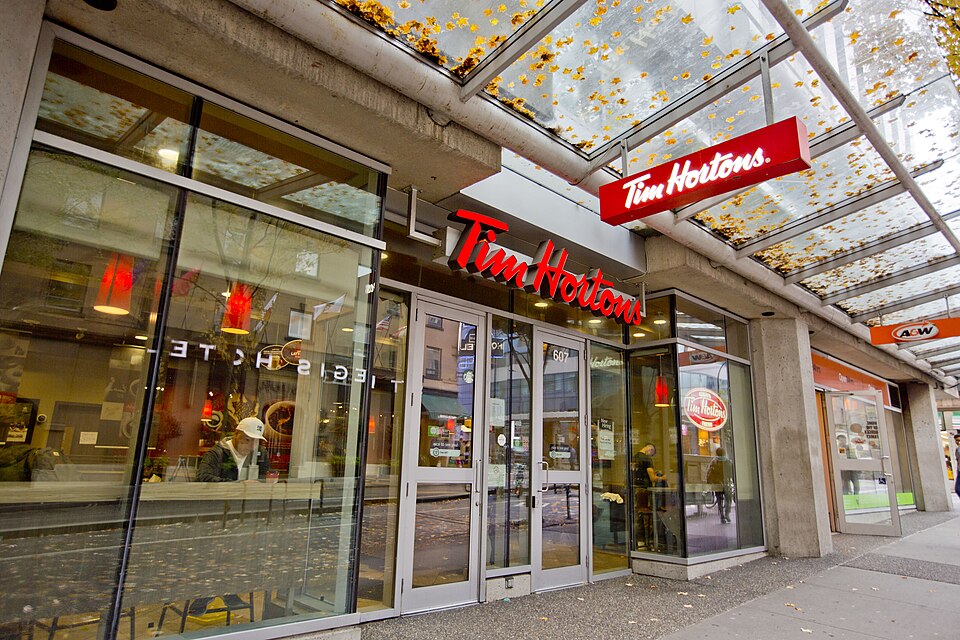
If you only get to know one fast-food brand in Canada, it has to be Tim Hortons (locals call it Tims or Timmies for short). It opened its first store in 1964 in Hamilton, Ontario, founded by former Toronto Maple Leafs defenceman Tim Horton and a partner; starting out with doughnuts, it later became the national coffee shop found on practically every corner. For many Canadians, drinking Tims is less about “whether it tastes good” and more a habit and an identity — you’ll see construction workers, office workers and students each holding a cup. When ordering for the first time, learn two terms first: Double Double means a coffee with “two creams, two sugars,” the most classic order, and staff will make it for you the moment they hear it; Timbits are the little round balls scooped out from the centre of doughnuts — a box holds many, in a mix of flavours, great for sharing in the office or coaxing kids. Its strength isn’t deliciousness but being “everywhere and fast”: when you want something hot for breakfast, or want a washroom plus a coffee on a long drive, Tims almost never lets you down; the downside is just as plain — the coffee flavour leans mainstream and the food is fairly standardized, so don’t come here looking for something refined. If you’re rushing, on a tight budget, and want to blend into local daily life, ordering a Double Double plus a box of Timbits on your first visit basically completes the ritual of the “first Canadian experience.”
Many people in Taiwan have never heard of A&W, but in Canada it’s a common brand of the tier just below Tim Hortons, with over a thousand outlets nationwide. The most memorable thing is its signature drink, root beer — traditionally served in a frosted, chilled mug. Taiwanese people trying it for the first time usually have polarized reactions: some think it’s like an herbal-tea soda, others become regulars after one taste, so it’s well worth ordering one as a cultural experience. On the burger side, A&W takes the “proper fast-food burger” route, headlined by the Burger Family series (the different sizes each have their own names), and also offers its own-recipe plant-based meat burger, which vegetarians or the curious can order to compare. Overall the flavour is a bit more thoughtful than Tims’ food, and the portions feel more like a full meal. If you want a filling burger and also want to try something “only commonly seen in Canada / North America,” A&W is a great fit; bring elders or kids along, and that chilled root beer usually becomes a talking point.
Harvey’s is the most “homegrown Canadian” of these four, founded in 1959, mainly concentrated in Ontario, and rarer the further west you go. Its memorable points are the flame-grilled burgers and the ordering process: after you pick your patty, the staff ask you face-to-face at the toppings counter what you want to add — lettuce, tomato, onion, pickles, and various sauces, all yours to combine, which means every burger is made-to-order and customized. For people with eating preferences (no onion, extra pickles, sauce or no sauce), Harvey’s interactive ordering will make you feel looked after, and that’s also its biggest difference from standardized fast food. Note that it has relatively few locations — it’s easier to find around Toronto, but in west-coast cities you may have to specifically check the map. If you’re picky and used to having “burgers made my way,” just tell the staff your toppings up front on your first visit; that’s exactly how it’s meant to be played.
Subway has a huge number of outlets in Canada, at almost the same density as Tim Hortons, and the upside for Taiwanese travellers is: you probably already know how to order. The process is the same — pick your bread, pick your main filling, pick your veggies and sauces, all made fresh. For someone who’s eaten fried food and burgers for several days straight and wants to switch to some vegetables, it’s just about the easiest “light option” to find. A small tip when ordering: portions come in two sizes, 6-inch and Footlong (about 12 inches), the latter suited to big appetites or splitting into two meals; staff will step by step ask whether you want toppings added, whether you want it toasted, and which sauce — if you’re unsure, you can just say “same as the picture.” If your English isn’t fluent yet, Subway is actually a good place to practise ordering, because at every step there’s something to point at and something to choose — to avoid deep-fried food, control your own calories and contents, or find a low-pressure setting to practise ordering in English, it’ll be your first choice.
About prices: please rely on in-store and the official app
Many articles pin down fast-food prices, but tax rates differ by province in Canada, brands also adjust often, and on top of that prices have moved a lot in recent years, so writing “a coffee costs X dollars, a burger costs X dollars” as a fixed figure is actually easy to mislead. The more practical approach is: download each brand’s official app (Tim Hortons, A&W and Subway all have one) — they have the most accurate current menu and prices, and often member coupons too; remember the checkout total will have each province’s sales tax added on, and the listed price you see is usually pre-tax; as for tips, counter-order-style fast food usually doesn’t require one, but some stores’ card machines will pop up a suggested-tip option, and pressing “No Tip / skip” is completely fine — no need to feel pressured.
On a first visit, which of these four should you eat at first?
If you could only pick one as your “first Canadian fast-food experience,” I’d suggest going to A&W first for a burger with a chilled root beer, then on another morning swinging by Tim Hortons on your way for a Double Double — these two combos best let you quickly feel “ah, this really is Canada now.” Harvey’s and Subway are left for the days you want to eat a bit more refined or a bit lighter.
Fast food is only the starting point for getting to know a country. Once you’re tired of the chains and want to move toward grocery shopping and local restaurants, you can go on to read our compiled Canada Life Guide, which has more everyday information you’ll use after settling in; to plan eating-and-drinking routes between cities, you can also check articles in the Canada Travel category.