
Last updated: 2026-06-17 | Rental costs, insurance terms, winter-tire rules and national-park admission fees may all change. Before you set out, rely on the official announcements from the rental company, each province’s transportation ministry and Parks Canada.
Canada is well suited to driving, but the thing it most easily makes you underestimate is “distance.” What looks on the map like just a line between two cities can in reality be a full day of mountain roads, unpredictable weather, and cell-phone signal that comes and goes. So rather than starting with a long list of beautiful attractions, I’d rather first lay out car rentals, insurance and winter rules clearly—if you don’t handle these few things well, even the most beautiful route turns into a source of stress.
“Driving in Canada” actually covers several completely different situations, and what you need to prepare differs as well. Before comparing rentals and insurance, putting yourself in the right category will save a lot of hassle. For short trips within a city, parking fees and one-way streets are more of a headache than fuel costs, and downtown public transit is often more convenient; for long-distance travel between cities, distance and rest rhythm are the key, and you should try to keep a single day’s driving within a reasonable range; while for national-park road trips of the kind found in the Rocky Mountains or on Vancouver Island, you need to pay special attention to the spacing between gas stations, national-park admission, and winter-tire rules.
| Scenario | Key point | Who it suits |
|---|---|---|
| Short trips within a city | Parking fees and one-way streets are more of a headache than fuel costs, and downtown public transit is often more convenient | Travellers staying only a few days in Toronto or Vancouver |
| Long-distance travel between cities | Distance and rest rhythm are the key; try to keep a single day’s driving within a reasonable range | Travellers wanting to link two or three cities |
| National-park road trips | Pay attention to the spacing between gas stations, national-park admission, and winter-tire rules | Nature routes such as the Rocky Mountains and Vancouver Island |
Car Rentals and Insurance: Documents, Age, and the Trick of Not Double-Buying
In most cases, overseas travellers can drive in Canada on a valid licence from their home country, but there are a few details to confirm in advance so you don’t get stuck at the counter. When it comes to your driver’s licence and International Driving Permit (IDP), if your licence is not written in English or French, you usually need to have an International Driving Permit or an officially certified translation ready, to be used together with your original licence; the IDP cannot be used on its own and must be paired with the original, and travellers from Taiwan can arrange it at the licensing authority before departure. The minimum rental age is generally 21, while in Quebec and Saskatchewan it is 18; drivers aged 21 to 25 are usually charged a “young driver fee,” so factor this cost in when comparing prices. When you pick up the car you usually also need to present a passport as a second piece of identification, so remember to carry it with you.
When comparing prices, don’t look only at the basic daily rate. One-way drop-off fees, mileage limits, fuel policies and additional-driver fees are often what make the bill balloon. The lowest price is not necessarily the best deal—a saying that is especially true for car rentals in Canada.
Rental insurance is the place where beginners most easily go wrong; it’s not a case of the more the better, but of being clear about what you already have and what you’re missing.
| Insurance item | What it does | Common situation |
|---|---|---|
| Collision Damage Waiver (CDW / LDW) | Reduces your liability for collision and scratch damage to the rental car itself | Some credit cards already include it; call first to confirm the scope of coverage |
| Third-party liability insurance | Protection when you cause damage to another person’s vehicle or body | Credit-card insurance mostly does “not” cover this; this part cannot be skipped |
| Credit-card included insurance | May offset the CDW, but with many conditions | Often excludes specific vehicle types, exceeds the rental-period day limit, or specific countries |
The recommended approach is: first call the bank that issued your credit card and ask clearly about the vehicle types, day limit and exclusions of its rental insurance; once you’ve confirmed which parts you aren’t covered for, top up the rest with the rental company, especially third-party liability. Buying duplicate coverage is a waste of money, but having no third-party liability protection at all is a real risk.
Winter and Mountains: Take BC’s Winter-Tire Rules Seriously
If your trip falls in autumn or winter, or passes through mountain highways, tire rules are not a suggestion but the law. On BC’s designated routes, winter tires or chains are required in most cases from October 1 to April 30 each year; for some sections that don’t go over mountain passes and have less snowfall, the rule runs to March 31—the actual route will have regulatory signs posted along the highway, and once you see a sign you must comply. The qualified winter-tire standard is that the tread must be marked with the three-peak mountain snowflake symbol (3PMSF) or the words M+S (mud-and-snow tire), with a tread depth of at least 3.5mm.
Failing to fit winter tires or chains as required on a designated route carries a penalty of about 109 to 121 Canadian dollars; but the more practical risk is that a vehicle losing control on snow is unsafe for everyone. If your trip includes mountain or winter sections, you should confirm when booking with the rental company whether the vehicle is already fitted with qualified winter tires, rather than finding out at the foot of the mountain that it doesn’t meet the rules. For the actual route and the latest rules, rely on the official announcements of the BC government’s transportation ministry, and checking the road conditions for the day before you set out is also well worth it.
Once you’ve handled all of the above, picking a route becomes much easier. Canada’s highway scenery really does live up to its reputation, but the “difficulty” of each route varies greatly, so factor in your own driving experience when choosing a route.
| Route | General characteristics | Who it suits |
|---|---|---|
| Rocky Mountains – Icefields Parkway (Highway 93) | Connects Banff and Jasper, about 232 kilometres in total, with glaciers, lakes and mountain views densely packed along the way | People willing to drive slowly and stop frequently for photos |
| Vancouver Island | Coastal and forest scenery, with relatively easy road conditions | Beginners driving in Canada for the first time |
| Towns around Lake Ontario | Shorter distances and dense supply points, suitable for short trips | Families who want an easy self-drive |
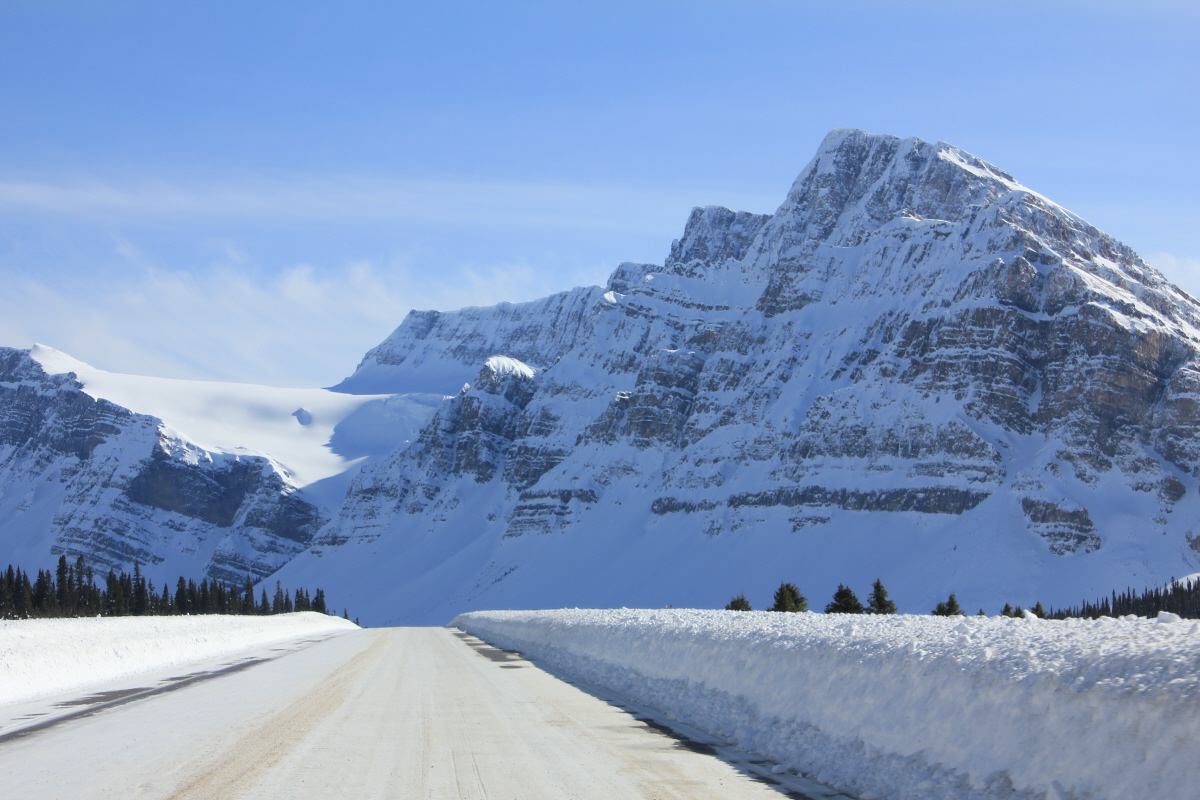
Take the most popular Icefields Parkway as an example: a first drive from Banff to Jasper should allow at least 4 hours of driving time, but as long as you stop at viewpoints such as Peyto Lake, Bow Lake and the Columbia Icefield, a whole day actually won’t feel like too much. One thing to note in particular: gas stations along this road are few and usually only open in summer, so be sure to fill up at Jasper or Lake Louise. The winter-tire rule on the Icefields Parkway usually runs from November 1 to April 1, so if you plan to go in winter, confirm it first.
Taking the Rocky Mountains route, you’ll also pass through national parks such as Banff and Jasper, which require purchasing a Parks Canada entry pass (either a Day Pass or the annual Discovery Pass); have it ready on the website or at the entrance before you get in the car to save queuing on site. Fees and discount plans are adjusted year by year, and Parks Canada occasionally offers limited free-entry or discount periods, so for the actual amounts and applicable dates rely on the announcements on the Parks Canada official website, and remember to include this in your trip budget as well.
Finally, a few principles I personally stick to on long drives: schedule at most one long-distance stretch per day, and for sightseeing self-drives keep a single day’s driving within 3 to 5 hours, because taking photos, eating and resting all stretch out the time; try to arrive at your accommodation before dark, especially in the mountains; before setting out, download offline maps and prepare charging cables and drinking water, as signal is often unstable in the mountains and on long stretches; for long routes, check the spacing between gas stations in advance and don’t wait until the fuel gauge hits empty to look for a station; if you see wildlife, stay in the car and keep your distance—don’t get out and approach. The last point is also the most important—never drive while fatigued; this is the biggest safety variable in long-distance driving in Canada.
Another frequently asked question: do travellers from Taiwan absolutely need an International Driving Permit to self-drive in Canada? Because a Taiwanese licence is written in Chinese, not English or French, you usually need to have an International Driving Permit or an officially certified translation ready, carried and used together with your original licence, as the International Driving Permit cannot be used on its own. It’s safer to arrange it before departure, though the actual requirements still depend on the rental company and each province’s rules. For details on accommodation, transportation, mobile phones and banking after you land, you can refer to my Canada Life Guide; and if you want to find more travel inspiration beyond self-driving, the Canada Attractions Roundup and the Canada Map can both help you first get a clear sense of the relative positions of cities and routes, making your itinerary easier to plan.


Leave a Reply