
Updated: 2026-06-17 | Ticket prices, schedules and match fixtures are subject to change; please refer to official announcements as authoritative.
Four days in Toronto sits right in the sweet spot between “really getting to know a city” and “conveniently folding Niagara Falls into the trip as well.” It’s a lot more relaxed than two or three days: you can take the downtown core, the lakeshore, the neighbourhoods and the museums slowly, one per day, and save a whole day for the falls at the end, rather than cramming it into some afternoon and running yourself ragged getting there and back. Below is the rhythm I’d arrange it in myself, offered as a reference for first-timers who don’t want to spend every day changing transit lines. By the way, if you’re coming in the summer of 2026, the city’s atmosphere will be very different from usual—Toronto is one of the FIFA World Cup host cities, and during match periods the crowds, accommodation and transit in the downtown core will all be noticeably stretched. I’ll cover this separately later on.
I tend to think of Toronto as “three days of city plus one day in the surrounding area”: the first three days stay in the city, and the last day heads out to Niagara. The advantage of arranging it this way is that you don’t have to keep moving your luggage, and the falls day can be enjoyed more fully. The table below is the skeleton; the order can be adjusted according to the weather.
| Day | Theme | Rough content |
|---|---|---|
| Day 1 | Downtown and the lakeshore | Around the CN Tower, the Harbourfront lakeshore; first build a sense of direction in the city |
| Day 2 | The islands and the west-end neighbourhoods | Outdoors on the Toronto Islands, then back in the afternoon to Queen West and Kensington Market to shop and eat |
| Day 3 | Museums and the cultural line | ROM or AGO, the Distillery District; an indoor backup day that holds up even in the rain |
| Day 4 | Niagara Falls | Take the GO Train out of the city, a whole day for the falls and the surrounding area |
Toronto summers see the occasional afternoon thunderstorm, so scheduling the outdoor days (Day 1, Day 2) for whichever days have a steadier forecast, and treating the indoor museum day as a rain buffer, is a lot more comfortable than rigidly sticking to the table.
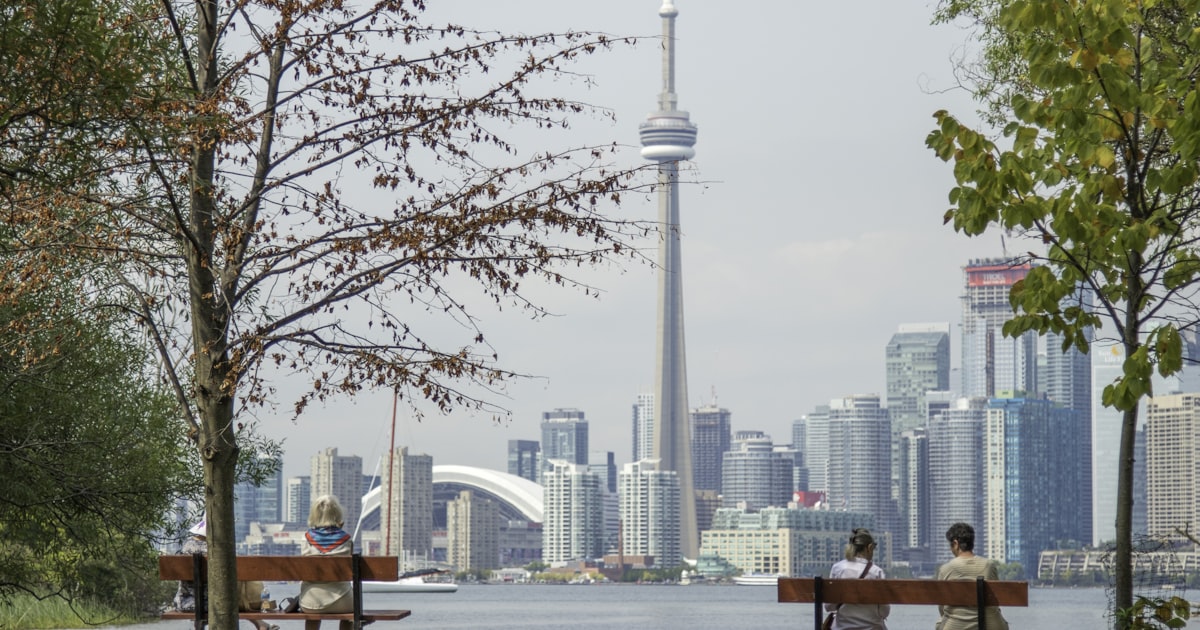
I wouldn’t pack Day 1 too tightly; the aim is first to figure out which part of the city you’re in. The CN Tower is the fastest way to build a sense of direction—looking down from the observation level, the lake, downtown, the stadium and the island all line up at once, and walking around over the next few days becomes much more intuitive. Ticket prices have been adjusted several times in recent years, and they’re split between the regular observation level, the glass floor, and the highest SkyPod, with a sizeable price gap; opening hours also shift with the season and special events, so for the actual ticket prices and opening times please refer to the CN Tower official website. There’s occasionally a difference between on-site and online prices too, so it’s worth checking again before you set out. If you want to experience the EdgeWalk around the outer edge of the tower, it requires a separate booking and costs a lot more; those afraid of heights should know their limits. After the tower, walking south brings you to the Harbourfront lakeshore—strolling along Lake Ontario, sitting down for a drink, and wrapping up the first day by the water is, to my mind, the least tiring way to open the trip.
Day 2 is for the outdoors. The Toronto Islands are where Toronto residents picnic, cycle and look at the skyline in summer; it’s a dozen-odd minutes across by ferry, and the atmosphere is a completely different world from downtown. The ferry departs from the Jack Layton Ferry Terminal (at the corner of Bay Street and Queens Quay). Per the City of Toronto’s announced fares, the ferry costs 9.57 Canadian dollars for adults, 6.15 for students and seniors, and 4.51 for children under 14, while children under 2 ride free; the fare already includes the return trip, so you don’t need to buy again on the way back. Only in summer (roughly mid-April to mid-October) do all three routes run in full (Centre Island, Hanlan’s Point, Ward’s Island); in autumn and winter the sailings are sharply reduced, and peak-season weekends see big queues, so it’s best to arrive early or buy tickets in advance on the official website. After coming back from the island, don’t rush back to the hotel—next, walk the west end’s Queen West and Kensington Market, where cafés, second-hand shops, graffiti walls and street food from all over are concentrated; this is the area where I feel Toronto’s “everyday face” comes through most, and on the way you can also duck into Graffiti Alley for a few photos.
Day 3 is scheduled indoors, conveniently giving feet that have spent two days outdoors a bit of a breather. Of Toronto’s two major museums, just pick one based on your interest: for natural history and artifacts choose the ROM (Royal Ontario Museum), for visual art choose the AGO (Art Gallery of Ontario); both are very large, and forcing both into the same day just turns it into a rushed once-over. In the afternoon you can carry on to the Distillery District, a pedestrian quarter converted from old red-brick factory buildings, with restaurants, small shops and galleries all inside; when the lights come on at dusk the atmosphere is lovely, making it well suited to wrapping up the evening with dinner. Each museum’s ticket prices, opening hours and special-exhibition runs are subject to change, so please refer to the latest announcements on the ROM and AGO official websites as authoritative.
Day 4: A whole day for Niagara Falls
The biggest advantage of a four-day itinerary is being able to spend a whole day properly going to Niagara, rather than rushing it in half a day. The most hassle-free way to get there from downtown is the GO Train—GO Transit runs from Union Station direct to the Niagara Falls GO station, a journey of about two and a half hours, with fewer departures on weekdays (about three) and more on weekends and some holidays. Niagara Parks has officially launched a combined package of the GO Train plus the WEGO shuttle bus; per the current information on the official website:
- Weekdays: 1-day package 34 Canadian dollars, 2-day package 40 Canadian dollars
- Weekends: 1-day package 22 Canadian dollars, 2-day package 35 Canadian dollars
- Children’s packages for ages 3 to 12 start from 9 Canadian dollars; children under 12 ride the GO Train itself free
The package includes a round-trip GO Train ticket and unlimited rides on the WEGO buses in the falls area (including service to Niagara-on-the-Lake), and the 2-day version also includes the falls cable car (Incline Railway). Note that this transit package is non-refundable, and that schedules and prices will be adjusted, so before you set out be sure to reconfirm the day’s times and fares on the GO Transit and Niagara Parks official websites. Attractions such as the falls boat tour (Niagara City Cruises) and Journey Behind the Falls require separate tickets.
For accommodation, try to choose the Downtown, Union Station or Entertainment District area, or somewhere along the subway (TTC) lines, to save commuting time each day; if your budget is limited you can stay a little farther out along the subway lines, trading travel time for a lower room rate. When working out a total budget, I’d suggest estimating accommodation, transit, admission, meals, tax and tip, and a contingency fund separately, rather than looking only at a single ticket price. The things most likely to blow the budget in Toronto are accommodation and intercity transport, and restaurant bills add tax and tip on top (around fifteen percent or so)—all of which needs to be factored in beforehand.
If you’re coming in the summer of 2026: the World Cup changes everything
If your four days fall in June or July 2026, you absolutely must factor in the World Cup. Toronto’s BMO Field is one of the host stadiums for the FIFA World Cup 2026, hosting six matches in total, including five group-stage matches (June 12, 17, 20, 23 and 26) and one round-of-32 knockout match (July 2), of which the June 12 opening match for the Canadian team is the first time the men’s World Cup has kicked off on Canadian home soil. This means that on match days, the crowds and transit pressure around the downtown core, the lakeshore and Union Station will rise noticeably, and accommodation prices will climb along with them—the earlier you book, the better. If you’re not here for the football, you can deliberately keep outdoor plans like the island and shopping off match days; if you’re here specifically for the matches, then accommodation and your return travel need to be arranged even further in advance. The exact fixtures, ticketing and venue rules may all change, so please refer to the official FIFA and host-city announcements as authoritative.
Finally, a few pitfalls I’ve watched a lot of people step into. The first is underestimating travel time: it looks close on the map, but in reality, adding in waiting for transit, transfers and walking, it’s often longer than you’d imagine—leaving a stretch of flexibility each day is more realistic than cramming in every sight. The second is charging at popular restaurants without a reservation; weekend brunch and in-demand restaurants often involve a queue, and booking ahead saves a lot of time. The third is only thinking about booking a room on the event day itself; during the World Cup, long weekends and major concerts, failing to book early leaves both room rates and availability in a sorry state. The fourth is having no rain backup; treat museums, markets and shopping centres as interchangeable indoor options, and on a rainy day just reorder the schedule.
Is four days actually enough? I’d say yes, and that it’s a relatively comfortable length—three days in the city plus one day at the falls lets you walk the CN Tower, the islands, the museums and the neighbourhoods, without having to compress any single day into a rush for the sake of the falls. What usually trips people up isn’t the number of days, but failing to sort out accommodation, intercity transport and restaurant reservations beforehand—especially in the summer of 2026 with the World Cup, these few things need handling even earlier. The ticket prices, schedules and opening times in this article all change with the season and policy, so for the latest information on the CN Tower, the Toronto Islands ferry, GO Transit and the various museums, please return to the official pages to confirm once more before you set out. To extend your planning, you can go on to read the Toronto guide for the city’s key points, or first read where to watch the World Cup in Canada together with Toronto-related articles, and work the match days into your itinerary as well.
Leave a Reply