
Updated and checked: 16 September 2026 | Historical goals review
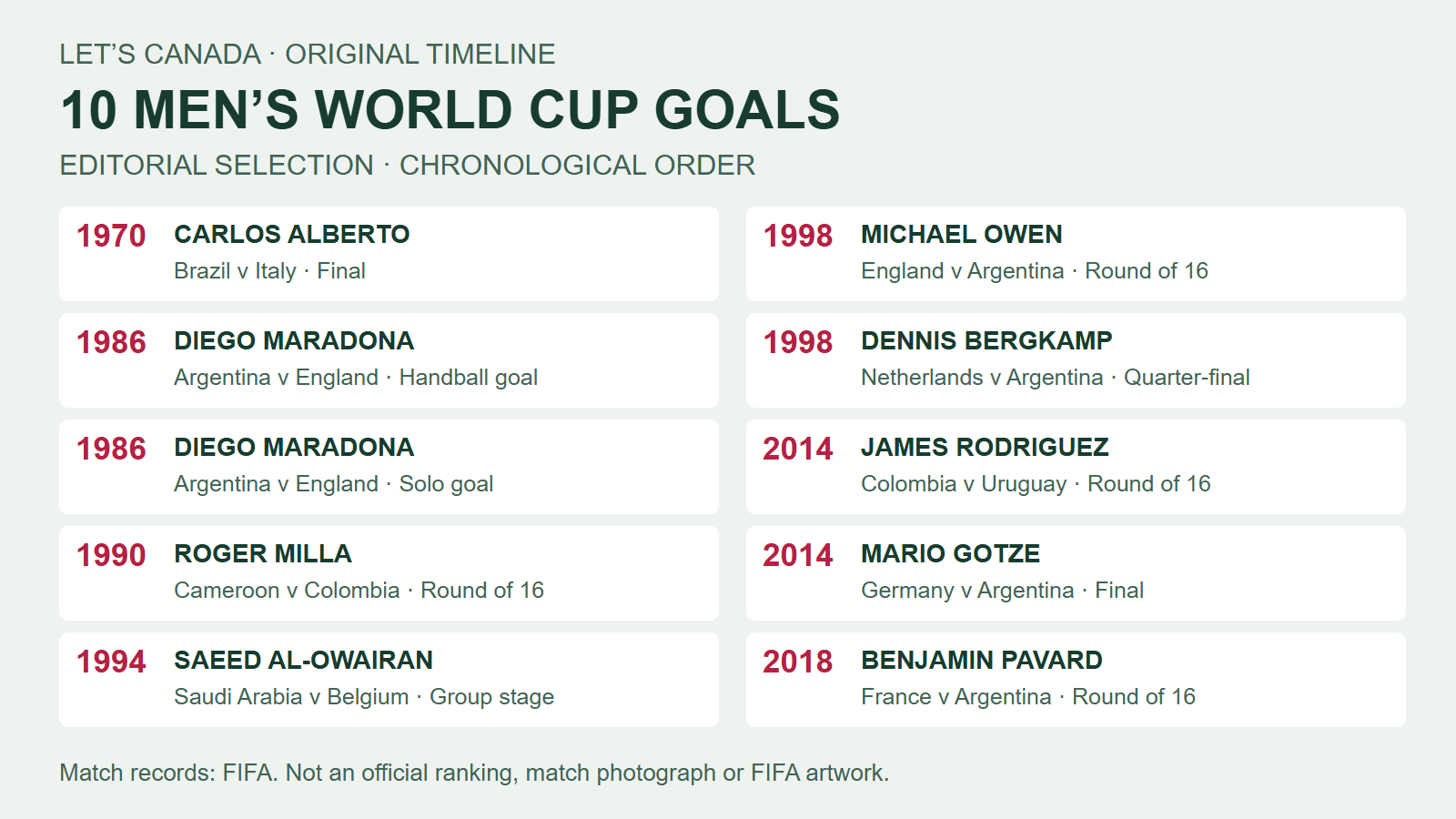
These ten goals show different sides of the men’s World Cup: passing moves, individual runs, finishing and disputed decisions. This is an editorial selection in chronological order, not FIFA’s all-time top ten. Carlos Alberto’s finish to Brazil’s 1970 team move counts once; Maradona’s handball and solo run in 1986 are two different goals in the same match. This is a historical review, not ticket-buying advice for 2026.
From the 1970 final to the 2018 knockout stage
In the 1970 Brazil–Italy final, Carlos Alberto finished a team move in the 86th minute to make the final score 4–1. FIFA’s final retrospective describes Clodoaldo beating defenders and a passing sequence involving several players. The reason for including it is the build-up before the finish. Listing the “Carlos Alberto goal” and the “Brazil team goal” separately would count the same event twice; several players participating does not mean all eleven touched the ball. FIFA’s final-goals feature also identifies Pelé’s final pass.
In Argentina’s 1986 quarter-final against England, Diego Maradona used his hand to score in the 51st minute. The referee allowed the goal, remembered as the “Hand of God”. FIFA’s match retrospective explicitly describes the handball. It is included for its historical controversy, not as an example of legal technique: a goal being awarded at the time does not mean no handball occurred.
In the 55th minute of that quarter-final, Maradona carried the ball from his own half, beat goalkeeper Peter Shilton and scored. FIFA calls this the “Goal of the Century”. It is separate from the handball four minutes earlier; Argentina won 2–1. His control, changes of direction and finish offer specific things to watch without claiming that everyone ranks it first.
In Cameroon’s 1990 round-of-16 game against Colombia, Roger Milla dispossessed René Higuita outside the penalty area in extra time and scored. The video label in FIFA’s feature says 108 minutes; that is the label cited here, without conflating it with Milla’s other goal in the match. FIFA’s tournament retrospective confirms his brace and Cameroon’s 2–1 win. This illustrates the opportunity created by pressing a goalkeeper in possession, not a rule that every venture out of goal is a mistake.
In Saudi Arabia’s 1994 Group F match against Belgium, Saeed Al-Owairan ran from his own half to score after five minutes; Saudi Arabia won 1–0. FIFA’s feature documents the run and result. It was a group-stage goal, not a late knockout winner. Comparing his solo run with Maradona’s still requires attention to the different opponents, defensive positions and tournament stages.
In England’s 1998 round-of-16 match against Argentina, 18-year-old Michael Owen took David Beckham’s pass and broke through to put England 2–1 ahead. The video in FIFA’s 2026 feature says 16 minutes; its 2020 match retrospective lists 17. Both labels are disclosed here. The match ended 2–2 and Argentina won the shoot-out 4–3, so this spectacular goal was not an England winner.
Late in the Netherlands’ 1998 quarter-final against Argentina, Dennis Bergkamp controlled Frank de Boer’s long pass, cut past Roberto Ayala and finished with the outside of his right foot for a 2–1 victory. The same FIFA feature says 89 minutes in its prose and 90 in its video label. Neither is presented here as an undisputed exact minute. The three-touch sequence is the point of interest, beyond the length of the pass.
James Rodríguez opened the scoring after 28 minutes in Colombia’s 2014 round-of-16 match against Uruguay, which Colombia won 2–0. The goal won both that World Cup’s Goal of the Tournament and the 2014 FIFA Puskás Award. The Puskás Award began in 2009 and is distinct from a World Cup’s goal-of-the-tournament vote. Winning it does not make this the only World Cup goal ever recognised by FIFA.
In the 2014 Germany–Argentina final, substitute Mario Götze controlled André Schürrle’s cross on his chest and scored in extra time to secure a 1–0 win. The video in FIFA’s 2026 feature says 112 minutes; its 2018 retrospective says 113. Both official labels are shown: the supported context is a late extra-time winner. Its effect on the match differs from Owen’s temporary lead in a game England ultimately lost.
In France’s 2018 round-of-16 game against Argentina, Benjamin Pavard scored after 57 minutes from Lucas Hernández’s pass to make it 2–2; France won 4–3. FIFA’s award record confirms that fans voted it Goal of the Tournament. It was an equaliser, not France’s final goal in the match. This distinct event completes the ten and helps separate visual appeal, award recognition and a goal’s actual effect on a game.
When revisiting memorable goals, consider the match situation alongside the move and result. Our reasons for selection are editorial observations; years, opponents, stages, scores and awards are grounded in the documents linked beside them. See our 1930–2022 champions retrospective and World Cup 2026 review for more context. Official video availability may vary by location and platform; we do not reproduce unlicensed footage.