
Updated and checked: 16 September 2026 | Historical scope: 1930–2022
From Uruguay’s inaugural men’s World Cup in 1930 to Argentina’s victory in Qatar in 2022, there were 22 tournaments. This review stops at 2022; it does not fold 2026 results into that historical total. Hosts and finalists can be checked against FIFA’s records for 1930–1978 and 1982 onwards, using only the latter’s entries through 2022 here.
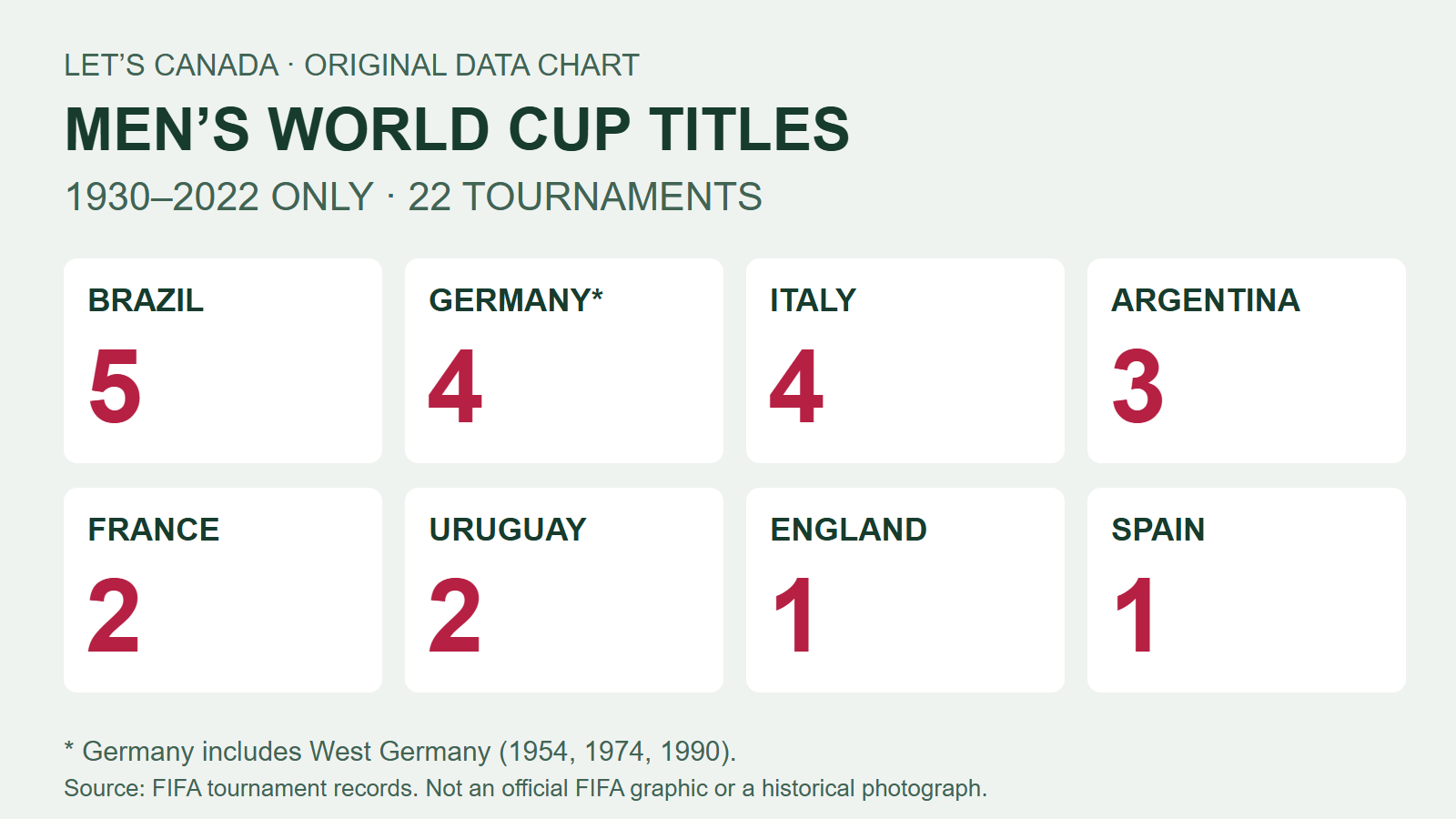
Through 2022, eight teams shared those 22 titles: Brazil five; Germany and Italy four each; Argentina three; France and Uruguay two each; England and Spain one each. Germany’s four include West Germany’s wins in 1954, 1974 and 1990, plus Germany’s 2014 title. Do not count the West German victories twice. The table retains historical team names such as Czechoslovakia rather than redistributing their records among present-day countries.
The first tournament had 13 teams and no qualifying competition. Uruguay beat Argentina 4–2 in Montevideo. UEFA’s 1930 review describes a group stage followed by semi-finals and a final. Italy then won in 1934 and 1938. The Second World War interrupted the competition: there were no tournaments in 1942 or 1946, leaving a 12-year gap from 1938 to 1950. FIFA’s historical profile corroborates the missing editions alongside its early champions record.
The crucial exception is 1950. Brazil, Uruguay, Sweden and Spain contested a round-robin final group, rather than a knockout bracket ending in a one-off final. On 16 July, Brazil needed a draw to become champions; Uruguay needed a win. Uruguay came from behind to win 2–1 at Rio de Janeiro’s Maracana and claim their second title. FIFA labels its Maracanazo match record “Final round”; its historical review explicitly distinguishes this game from a conventional final. “Runner-up” below means second overall, not the loser of a 1950 knockout final.
In 1958, 17-year-old Pele helped Brazil win their first title in Sweden, beating the hosts 5–2 in the final. Brazil retained the title in Chile in 1962 and won a third in 1970, beating Italy 4–1. FIFA’s Pele retrospective connects these campaigns and makes clear that he did not play through the whole 1962 tournament. That third title gave Brazil permanent possession of the Jules Rimet Trophy. FIFA’s trophy history records the new trophy introduced in 1974; permanent ownership of the old cup did not establish the same entitlement for later winners of the current original.
England beat West Germany 4–2 after extra time in 1966 for their only title through 2022. West Germany defeated Johan Cruyff’s Netherlands in 1974; Argentina beat the Dutch after extra time at home in 1978 for their first title. Opponents, scores and extra-time distinctions follow FIFA’s deciding-match archive. They do not imply that every edition used the same route to the final.
Maradona’s “Hand of God” and “Goal of the Century” were two different goals against England in the 1986 quarter-final, not the final. Argentina then beat West Germany 3–2 in the final. In 1994, Brazil and Italy remained goalless after extra time; Brazil won the shoot-out 3–2 in the first men’s World Cup final decided on penalties. France beat Brazil 3–0 at home in 1998, and Brazil won their fifth title by beating Germany 2–0 at Korea/Japan 2002. FIFA’s later champions record supports that sequence without reducing team achievements to a lone player’s work.
Italy and France finished extra time at 1–1 in 2006 before Italy won 5–3 on penalties. Spain’s first title came in South Africa in 2010 through Iniesta’s extra-time winner. Germany beat Argentina 1–0 after extra time in 2014 for their first title since reunification; France beat Croatia 4–2 in 2018. Argentina and France drew 3–3 in 2022 before Argentina won the shoot-out 4–2. FIFA’s review of the deciders records two goals for Messi and three for Mbappe in that match. Calling it the greatest final is an opinion, not an objective ranking with a common standard.
How to read the 22-tournament record
Scores put the champion first and show the score at the end of the match, with extra time and shoot-outs identified separately. Shoot-out kicks are not added to match goals. The exception is 1950: its row records Uruguay’s last final-round match against Brazil. The table is checked against FIFA’s early champions record and results and video index, with the specific 1950 sources discussed above.
| Year | Host | Champion | Runner-up | Score, champion first; match context |
|---|---|---|---|---|
| 1930 | Uruguay | Uruguay | Argentina | 4–2 |
| 1934 | Italy | Italy | Czechoslovakia | 2–1 (after extra time) |
| 1938 | France | Italy | Hungary | 4–2 |
| 1950 | Brazil | Uruguay | Brazil | 2–1 (final-round decider; not a one-off final) |
| 1954 | Switzerland | West Germany | Hungary | 3–2 |
| 1958 | Sweden | Brazil | Sweden | 5–2 |
| 1962 | Chile | Brazil | Czechoslovakia | 3–1 |
| 1966 | England | England | West Germany | 4–2 (after extra time) |
| 1970 | Mexico | Brazil | Italy | 4–1 |
| 1974 | West Germany | West Germany | Netherlands | 2–1 |
| 1978 | Argentina | Argentina | Netherlands | 3–1 (after extra time) |
| 1982 | Spain | Italy | West Germany | 3–1 |
| 1986 | Mexico | Argentina | West Germany | 3–2 |
| 1990 | Italy | West Germany | Argentina | 1–0 |
| 1994 | USA | Brazil | Italy | 0–0 (after extra time; penalties 3–2) |
| 1998 | France | France | Brazil | 3–0 |
| 2002 | South Korea / Japan | Brazil | Germany | 2–0 |
| 2006 | Germany | Italy | France | 1–1 (after extra time; penalties 5–3) |
| 2010 | South Africa | Spain | Netherlands | 1–0 (after extra time) |
| 2014 | Brazil | Germany | Argentina | 1–0 (after extra time) |
| 2018 | Russia | France | Croatia | 4–2 |
| 2022 | Qatar | Argentina | France | 3–3 (after extra time; penalties 4–2) |
All 22 titles in this period went to European or South American teams. Host winners were Uruguay in 1930, Italy in 1934, England in 1966, West Germany in 1974, Argentina in 1978 and France in 1998. These are historical results, not a rule that hosts will win. For the completed 2026 tournament, continue with our World Cup 2026 review or our 48-team format and groups article, keeping each edition’s records and rules separate.