
Content updated and fact-checked: 2026-09-17
Before changing a mobile or home Internet plan in Canada, identify what each charge is for. Telecom Regulatory Policy CRTC 2026-43 was issued on 12 March 2026; its Code amendments took effect and became enforceable on 12 June. The underlying Telecommunications Act amendments had already come into force on 30 October 2025. The announcement, legislation and Code enforcement dates are different. This guide explains the conditions checked as of 17 September 2026; the new rules do not automatically erase every amount owed when you switch providers.
Paragraph 29 of the policy distinguishes individual and small-business customers of all mobile wireless providers from individual home Internet customers of providers subject to the Internet Code. The Internet Code’s application section identifies large facilities-based Internet providers. Do not assume that the wireless rules’ coverage of all providers extends to every Internet reseller or business Internet contract. Check the service type, the company you are contracting with and the contract term.
Activation, changes and cancellation follow different rules
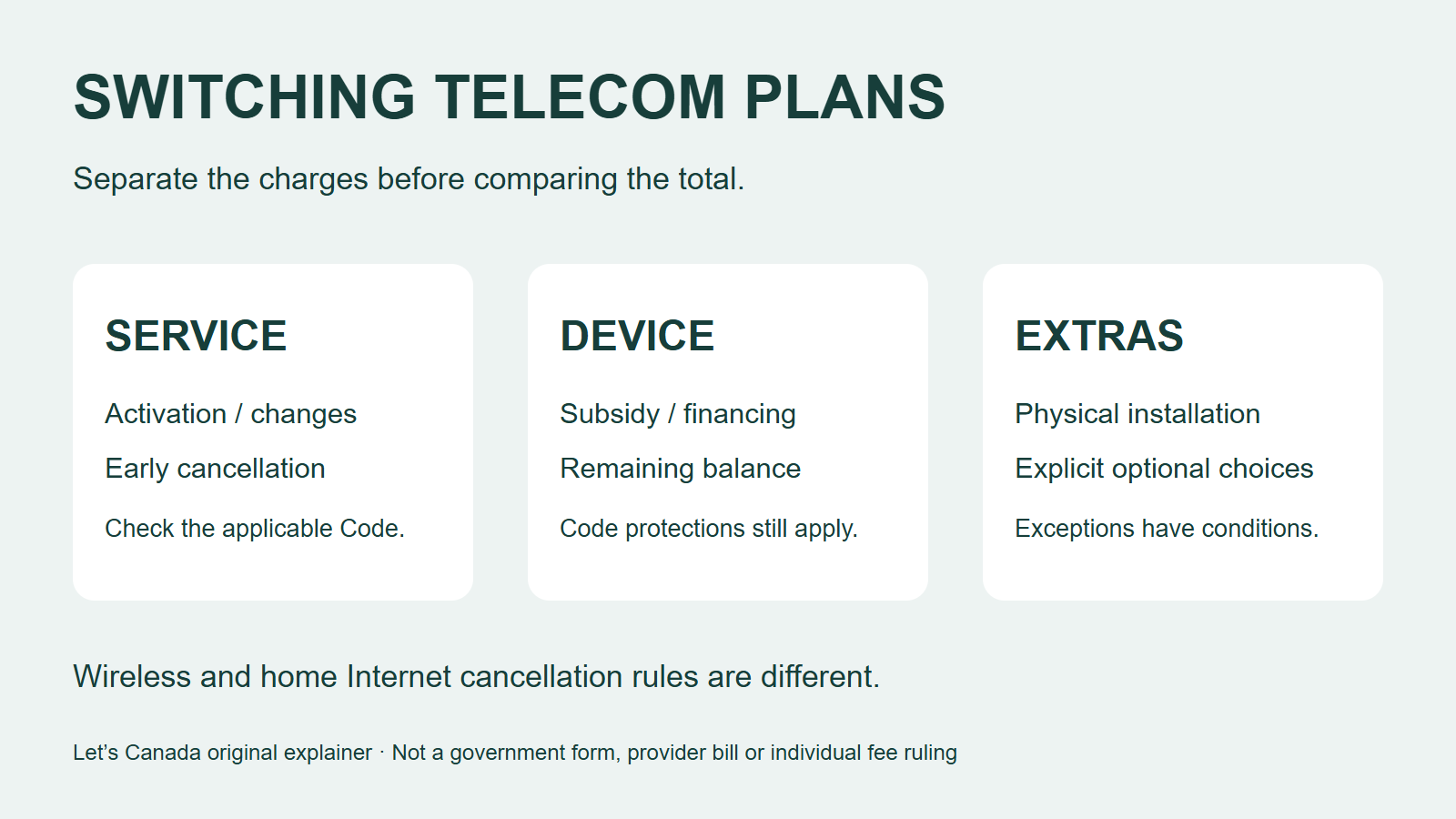
The prohibition covers charges arising from activating a new retail telecom plan or modifying an existing one. Paragraphs 17–19 of 2026-43 retain exceptions for reasonable physical installation costs at the customer’s premises and additional products or services the customer explicitly chooses, such as nonessential extra equipment or on-site Wi-Fi configuration. This does not make any charge lawful merely because it is renamed a setup fee, or turn a required item into an optional purchase.
| Contract situation | Early cancellation fee | Official provision |
|---|---|---|
| Mobile service without a subsidized device | No early cancellation fee, whether the contract is fixed-term or indeterminate. | Wireless Code G.3 |
| Fixed home Internet without a subsidized device, fixed-term contract | A fee disclosed in the contract may still apply. The charging period cannot exceed the shorter of 24 months or the contract term, with the fee reaching zero by its end. | Internet Code G.1.iii.a |
| Fixed home Internet without a subsidized device, indeterminate contract | No early cancellation fee. | Internet Code G.1.iii.b |
The home Internet rows apply only where the Code and the relevant provisions govern the contract. Its implementation section retains exceptions, including G.1, for contracts already in existence when the Code took effect on 31 January 2020 that have not since been renewed or amended. Not having a subsidized phone is therefore not enough to conclude that any fixed-term Internet contract can be ended early for free.
Cancellation protections did not first appear in 2026. G.3 of the 2017 Wireless Code already prohibited early cancellation fees for indeterminate contracts without a subsidized device. For fixed-term contracts without one, the historical cap was the lower of CAD 50 or 10% of the remaining monthly charges, reaching zero within 24 months. Paragraphs 20–21 of 2026-43 removed that fixed-term mobile fee as well. It is inaccurate to describe every earlier switch as having required a penalty.
Device subsidies, device financing and service activation charges need separate examination. Wireless Code G.2 limits subsidy-related early cancellation fees and requires monthly reductions. For an ordinary fixed-term contract, the maximum is the device subsidy, reduced to zero over the shorter of the contract term or 24 months; for an indeterminate contract, the maximum reduction period is 24 months. Tab contracts have their own reduction method. The subsidy is calculated from the Code’s device retail price minus the amount paid when the contract was agreed, not an arbitrary processing charge.
An unpaid phone is not automatically paid off by the new rules. However, financing is not outside regulation: paragraphs 49–53 of CRTC 2021-98 establish that device financing tied to wireless service is subject to the Wireless Code. A financing balance made repayable by service cancellation is treated as an early cancellation fee under the Code, with G.1 and G.2 protections. A device balance may therefore remain payable, but its calculation must respect those limits and cannot be supplemented with an arbitrary service-cancellation penalty. If the arrangement also provides for returning or buying out the device at the end, request separate details of the balance, return conditions and calculation. This guide does not treat every device-return plan as the same subsidy model.
Check the total cost, then handle number transfers and complaints
Compare the remaining device amount, any applicable contractual cancellation fee, lawful installation or optional charges, monthly price, discount period, taxes and the services you need. Ask for a written quote and an itemized amount for your proposed cancellation date, and confirm service availability where you live or travel routinely. Family, SIM-only and retention offers are options to compare, not guarantees of lower prices. Threatening to leave does not create a right to a discount. Our Canadian SIM and eSIM guide explains the underlying differences between device formats and plan types.
To keep your telephone number, the CRTC’s transfer guidance says to tell the new provider and have it arrange the transfer while the existing service remains active. Do not cancel first. The new provider must confirm eligibility; moving outside the local calling area or some VoIP transfers may limit portability. That guidance page’s older cancellation-fee section is not the basis for current 2026 charges. Use the current Codes and amendments linked above for fees.
If you dispute a charge, retain the contract, bill, cancellation date and customer-service correspondence. Identify the amount and rule at issue to the provider and give it an opportunity to respond. Under the CCTS complaint process, an unresolved issue can then be assessed by this independent ombuds service. Its official complaint page explains that the service is free and generally covers contract, billing, service-delivery and credit-management disputes, subject to its mandate. The CCTS resolves individual complaints; it does not guarantee every requested remedy or impose regulatory fines on providers.
Also distinguish future changes. The enhanced notification requirements announced in CRTC 2026-67 on 13 April 2026 take effect on 13 April 2027. Current Code pages already display some future provisions with an effective-date warning. Their appearance does not make those additional notification requirements enforceable rights in September 2026; they are separate from the fee prohibition enforced from 12 June.