
Content updated and checked: 2026-09-17
Buying a home in Vancouver involves more than one figure labelled property tax. Property Transfer Tax (PTT) at registration, annual property taxes and separate city and provincial vacancy taxes have different bases and declaration rules. This guide sets out the main rules applicable in 2026. Several early- and mid-year deadlines have already passed: distinguish the tax year from the filing date, and use the relevant authority’s process for a late case.
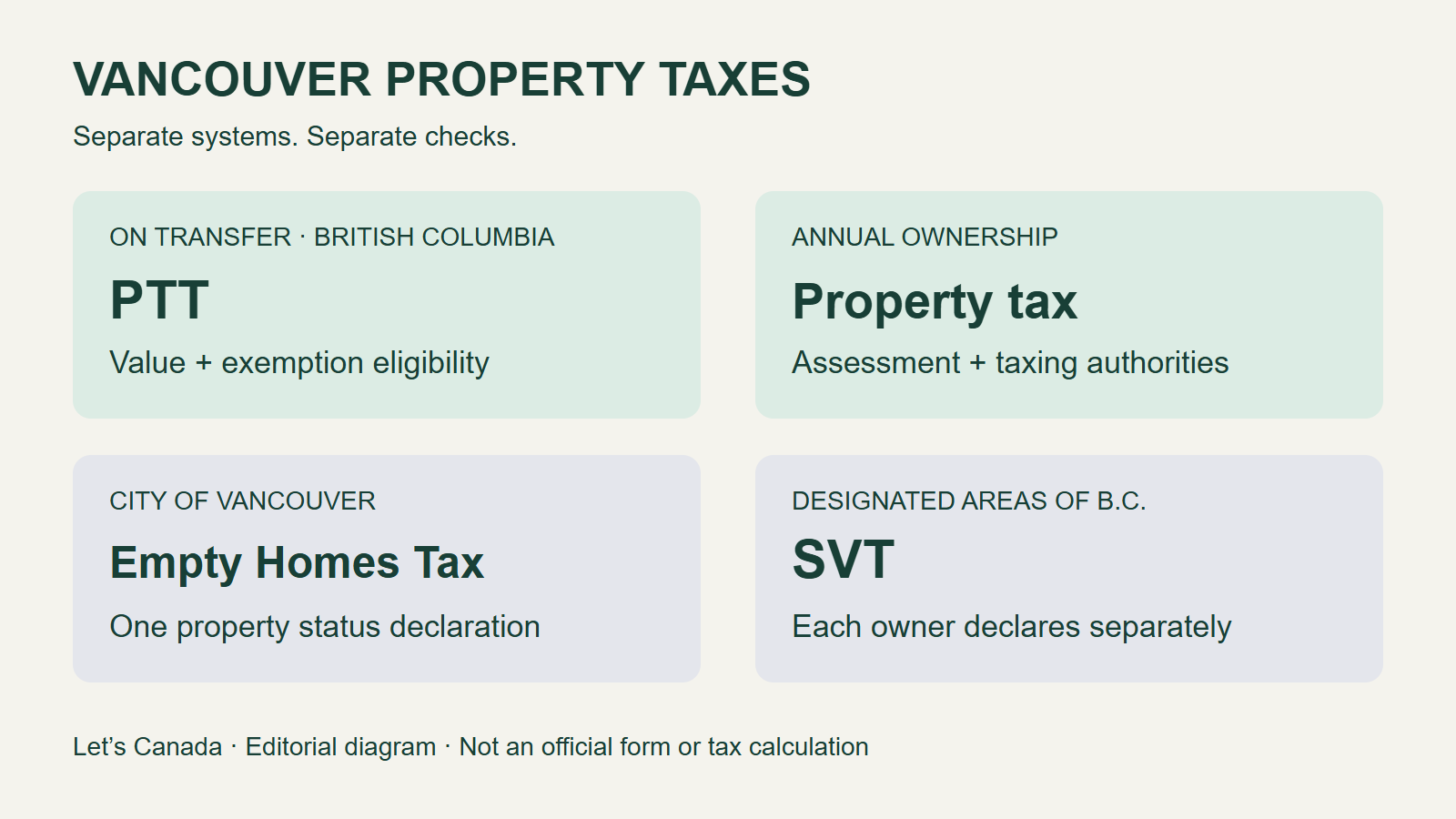
BC’s PTT guidance distinguishes the transaction tax from annual property taxes. The provincial SVT explanation also confirms that SVT and Vancouver’s Empty Homes Tax are separate systems. One home may require attention to all four:
| System | Event or procedure |
|---|---|
| BC Property Transfer Tax | Declare the transaction and any qualifying relief when acquiring and registering an interest in property. |
| Annual property tax | Pay the yearly notice covering City and other taxing authorities’ charges. |
| Vancouver Empty Homes Tax | Declare the status of a residential property in the city each year and pay any resulting tax. |
| BC Speculation and Vacancy Tax | Owners of residential property in designated areas individually declare their status, relevant income circumstances and property use. |
At purchase: establish the tax base, then check relief eligibility
General PTT is based on the fair market value of the interest acquired on the date of land-title registration; separate rules apply to cases such as pre-sold strata units. An open-market purchase price is usually an important indicator, but changes in market conditions or the property before registration, or a transfer outside the open market, may require further verification. BC Assessment values have their own valuation date. They are not automatically the current fair market value, and purchase price, assessed value and tax base are not interchangeable.
The general progressive rates are 1% on the first CAD 200,000, 2% on the portion above CAD 200,000 up to CAD 2,000,000, and 3% above CAD 2,000,000. A further 2% applies to residential value above CAD 3,000,000; for mixed-use property, this additional charge concerns only the residential portion. These are the provincial tax brackets, not a single highest rate applied to the entire property price.
The CAD 835,000 figure in the First Time Home Buyers’ Program is a fair-market-value eligibility threshold, not a promise of zero PTT below that amount. Under the exemption amounts for registrations from April 1, 2024, where the entire transfer qualifies and land and use conditions are met, value of CAD 500,000 or less can be exempt from general PTT. Above CAD 500,000 through CAD 835,000, the exemption is CAD 8,000. Above CAD 835,000 and below CAD 860,000, relief tapers off; at CAD 860,000, this first-buyer relief is unavailable.
For example, the official table shows CAD 14,700 in general PTT on a CAD 835,000 property. Subtracting CAD 8,000 leaves CAD 6,700 payable. This example assumes the full interest qualifies. If only some joint purchasers qualify, the entire transfer cannot be treated as eligible. The official amount and ownership-share guidance also accounts for land area and non-residential improvements.
Buyer requirements include Canadian citizenship or permanent residence at registration; either living in BC for at least the year immediately beforehand or filing at least two income tax returns as a BC resident in the preceding six taxation years; never having owned a registered interest in a principal residence anywhere in the world; and never having received this first-buyer exemption or refund. The standard full criteria also require sole use as a principal residence, land no larger than 0.5 hectares and residential improvements only. For an existing home, move in within 92 days after registration and occupy it continuously until the first anniversary—not merely until December. Moving out early, death and certain Family Law Act transfers have separate partial-relief or exception rules.
The Newly Built Home Exemption is a separate program and does not require this to be your first purchase. Where the home meets the definition, the buyer is a citizen or permanent resident, the completed improvement is being registered for the first time, and principal-residence and land criteria are met, fair market value of CAD 1,100,000 or less can qualify for full general PTT relief. Above CAD 1,100,000 and below CAD 1,150,000, partial relief may apply; it reaches zero at CAD 1,150,000. Normally, buyers must also move in within 92 days and remain for the rest of the first year. A listing described as new does not establish eligibility, and the two programs are not discounts to stack at will.
Foreign nationals, foreign corporations and taxable trustees must also check additional PTT: 20% on the fair market value of their acquired share of residential property in specified areas. These include the Metro Vancouver, Capital, Fraser Valley, Central Okanagan and Nanaimo regional districts; Tsawwassen First Nation treaty lands are excluded. Conditional exemptions exist, including for qualifying BC Provincial Nominees. Valid nomination, an individual transfer and principal-residence use must be checked, and a spouse is not automatically exempt. This tax is separate from federal restrictions on purchases by non-Canadians; paying it does not authorize a purchase.
During ownership: separate annual bills, use declarations and disputes
The 2026 budget approved on November 25, 2025 set a 0% increase in the City’s property tax, but did not guarantee an unchanged total bill for every owner. The City describes about half of charges on a property tax notice as going to the City, with the rest including provincial school taxes and levies for bodies such as TransLink and Metro Vancouver. That is an overall explanation, not a fixed split for every property. Annual property taxes are also separate from the PTT paid on a transaction.
BC Assessment’s explanation focuses on how a property’s value changes relative to the average for its property class in the same taxing jurisdiction, alongside budgets, tax rates and other factors. A 20% assessment increase does not mean a 20% tax increase; a lower assessment does not guarantee a lower total bill either. The percentage on an assessment notice alone cannot predict the tax due.
Vancouver’s Empty Homes Tax concerns residential property within the city. Property considered empty for the 2025 reference year is taxed at 3% of its 2025 assessed taxable value. Common non-taxable situations include use as the principal residence of an owner or another permitted occupier for at least six months, or residential rentals totalling at least six months in periods of at least 30 consecutive days. Separate exemptions cover circumstances such as death, qualifying major renovations and transfers of legal ownership; not every renovation or change to transfer documents qualifies.
The City requires an annual property status declaration, but one registered owner submits one declaration for the property, rather than every co-owner filing separately. Failure to declare can result in the property being deemed vacant. Moving in or paying annual property tax does not replace the declaration. Keep evidence of occupancy, rental periods or exemption eligibility for possible review.
BC SVT applies only in designated provincial areas, including Vancouver and other listed places, rather than throughout BC. Residential properties on reserve lands, treaty lands and other geographically excluded land are outside that scope. Under the general declaration process, each co-owner declares separately, even when the other owner is a spouse. This differs from City Empty Homes Tax. Special exclusions have their own rules; owners who should have received a letter but did not should contact the Province, not assume no declaration is needed.
For the 2026 SVT tax year, rates are 3% for foreign owners and untaxed worldwide earners, a category defined by provincial law, and 1% for Canadian citizens or permanent residents who are not in that income category. For 2025, the corresponding rates remain 2% and 0.5%, with declarations in 2026; property use in 2026 is declared in 2027. An increase from 2% to 3% is 50%; the change from 0.5% to 1% is a doubling. The rates here are for 2026: 3% must not be assumed to continue unchanged in every later year.
SVT does not depend solely on whether someone lives in a home. The provincial principal-residence exemption has citizenship or permanent-residence, BC income-tax residency and untaxed-worldwide-earner conditions. Renting for six months also remains subject to tenancy requirements, including special rules for non-arm’s-length arrangements. A home may therefore be exempt from the city tax but not the provincial tax, or vice versa. The two sets of conditions are not interchangeable.
The verified dates below all precede this review. The City’s deadline table and provincial declaration timeline cover different years and procedures. A late filing or payment must be handled through the relevant authority, rather than by applying one deadline to every tax:
| Item | Relevant year and 2026 date |
|---|---|
| Vancouver annual property tax | 2026 advance tax: February 3; main tax: July 3. |
| Vancouver Empty Homes Tax | 2025 reference year: declaration February 3; any tax due April 16. |
| BC SVT | 2025 tax year: declaration March 31; any tax due July 2. |
| Initial BC Assessment complaint | 2026 assessment notice: February 2 at 11:59 p.m. Pacific Standard Time; a separate assessment procedure. |
The BC Assessment PARP appeal guide confirms the February 2, 2026 deadline and that the 2026 assessment reflects the market on July 1, 2025. A complaint should address valuation or record errors with comparable-property evidence; this is not a way to change a tax rate simply because it is unwelcome. Start with BC Assessment; a PARP decision can be followed by a separate PAAB appeal. A complaint filed on time still requires preparation of hearing evidence. A late complaint or one with a substantive defect may be rejected.
For a disputed provincial SVT assessment, use the SVT appeal channels to establish which decisions are appealable and the applicable deadline, rather than copying the BC Assessment date. An appeal does not automatically suspend payment obligations. Contact the City for an annual municipal tax account or City Empty Homes Tax issue. This is general information, not an individual tax determination. Joint ownership, trusts, cross-border income and changes of use warrant case-specific review by the legal professional handling the transaction or a qualified tax professional. For other settlement and rental preparations, see the Canada life guide.